

Top 7 Industries That Use Modular Clean Booths
Contamination control is essential in many modern manufacturing and research environments. A modular clean booth provides a cost-effective way to create a local clean environment without constructing a full cleanroom facility.
By combining HEPA filtration, fan filter units (FFU), and vertical laminar airflow, clean booths can achieve controlled environments typically ranging from ISO Class 5 to ISO Class 8, depending on the design and airflow configuration. Cleanroom classifications are commonly defined under the International Organization for Standardization standard ISO 14644 Cleanroom Standards, which specifies particle concentration limits for controlled environments.
Because of their flexibility, quick installation, and lower cost, modular clean booths are widely used across many high-tech industries. Let’s introduce the top 7 industries that rely on modular clean booths for contamination control
1. Semiconductor Manufacturing
Semiconductor fabrication requires extremely strict contamination control. Even microscopic particles can damage integrated circuits during production.
Clean booths in semiconductor facilities for:
-
wafer inspection
-
chip assembly
-
packaging processes
-
component testing
A modular clean booth can create a local ISO Class 5 or ISO Class 6 environment within a larger manufacturing space, helping protect sensitive components from airborne particles.
Fan Filter Units (FFU) with HEPA filter mounted on the booth ceiling.
For more information about cleanroom standards used in semiconductor environments, refer to the guidelines published by the SEMI International Standards Organization.
2. Electronics Assembly
Modern electronics manufacturing involves assembling small and highly sensitive components such as circuit boards, sensors, and microchips.
Particles, dust, or electrostatic charges can easily affect production quality.
Modular clean booths for:
-
PCB assembly
-
sensor manufacturing
-
precision electronics assembly
-
inspection and testing stations
Many electronics manufacturers use static-dissipative wall panels to reduce electrostatic discharge, which helps prevent particle attraction and protects sensitive components.
A modular booth allows manufacturers to install a clean environment directly above production lines, improving product reliability without requiring a full cleanroom.
3. Pharmaceutical Production
Pharmaceutical manufacturing requires strict environmental control to prevent contamination of drugs and medical substances.
Clean booths for:
-
powder handling
-
sterile packaging
-
weighing and dispensing operations
-
sampling processes
These controlled environments often follow guidelines defined by the World Health Organization for pharmaceutical manufacturing and Good Manufacturing Practice (GMP) regulations.
By integrating HEPA filtration and laminar airflow, modular clean booths help maintain consistent air cleanliness levels and protect pharmaceutical products from contamination.
4. Medical Device Manufacturing
Medical devices must meet strict cleanliness and quality standards before they can be distributed to healthcare providers.
Clean booths help create controlled environments for:
-
device assembly
-
sterile packaging
-
inspection and testing
-
implantable device manufacturing
Local clean booths provide a controlled clean zone around critical processes, reducing the need for large-scale cleanroom construction.
Manufacturers can also install transparent panels to improve visibility and workflow while maintaining contamination control.
5. Optics and Precision Instrument Manufacturing
Precision optical components are highly sensitive to dust particles and airborne contamination.
Industries producing the following components often use modular clean booths:
-
camera lenses
-
optical sensors
-
laser components
-
microscopes
-
precision measurement instruments
Even microscopic particles can affect optical performance. Clean booths provide a stable environment where delicate optical components can be assembled, inspected, and packaged safely.
6. Laboratories and Research Facilities
Many research laboratories require controlled environments for experiments and sample preparation.
Clean booths in laboratories for:
-
sample analysis
-
biological research
-
pharmaceutical testing
-
chemical experiments
Unlike permanent cleanrooms, modular clean booths can be installed quickly and adjusted as laboratory needs change.
Because of their modular design, laboratories can easily expand or relocate clean booth systems as research projects evolve.
7. Food Processing and Packaging
Food safety regulations increasingly require clean environments for processing and packaging operations.
Clean booths can help control airborne contamination during:
-
food packaging
-
ingredient handling
-
quality inspection
-
nutritional supplement production
Using HEPA filtration and controlled airflow helps reduce airborne particles and microbial contamination, improving product safety and regulatory compliance.
Why Modular Clean Booths Are Popular Across Industries
Compared with traditional cleanrooms, modular clean booths offer several advantages:
Lower installation cost
A clean booth can create a localized clean environment without building a full facility.
Fast installation
Most modular clean booths can be installed within days rather than months.
Flexible design
Booths can be expanded, relocated, or customized according to production needs.
Energy efficiency
Because only a small area is controlled, energy consumption is significantly reduced.
These benefits make modular clean booths an ideal solution for many industries requiring contamination control.
Modular Clean Booth Solutions
Modern clean booths are designed with modular structures including:
-
aluminum frames
-
HEPA filtration systems
-
FFU fan filter units
-
LED cleanroom lighting
-
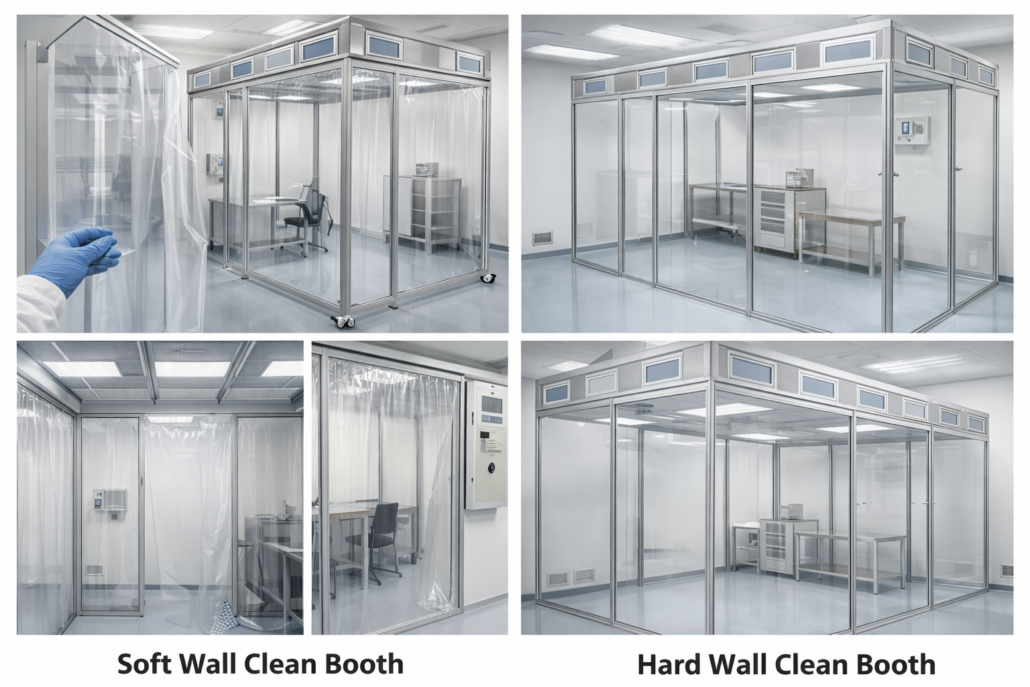
flexible or rigid wall panels
Depending on the application, clean booths can be configured as:
-
softwall clean booths
-
hardwall clean booths
-
portable cleanroom enclosures
Learn more about our modular clean booth systems here:https://flairequip.com/clean-booth/
Understanding Cleanroom Standards
Clean booths are typically designed according to the particle concentration limits defined by ISO cleanroom classifications.
Detailed information about these classifications can be found on the official website of the International Organization for Standardization:
https://www.iso.org/standard/53394.html
Understanding these standards helps manufacturers select the correct airflow and filtration design for their clean booth system.
Conclusion
Modular clean booths provide an efficient and flexible way to create localized clean environments for contamination-sensitive industries.
From semiconductor manufacturing and electronics assembly to pharmaceuticals and food processing, these systems help maintain product quality, improve operational efficiency, and comply with strict cleanliness standards.
As manufacturing technologies continue to evolve, modular clean booths will remain an important solution for industries that require reliable contamination control without the cost of a full cleanroom facility.
Contact Us
If you are planning a cleanroom project or need a customized clean booth solution, our engineering team can help design the right system for your application.
Website
https://flairequip.com
Email
linor@flairequip.com