

Side-Lifting (Side-Mounted) FFU: A Practical Guide for End Users & Contractors
1. What Is a Side-Lifting FFU?
A side-lifting FFU (Fan Filter Unit) is a cleanroom air supply unit designed to be installed vertically or laterally, rather than horizontally in a ceiling grid.
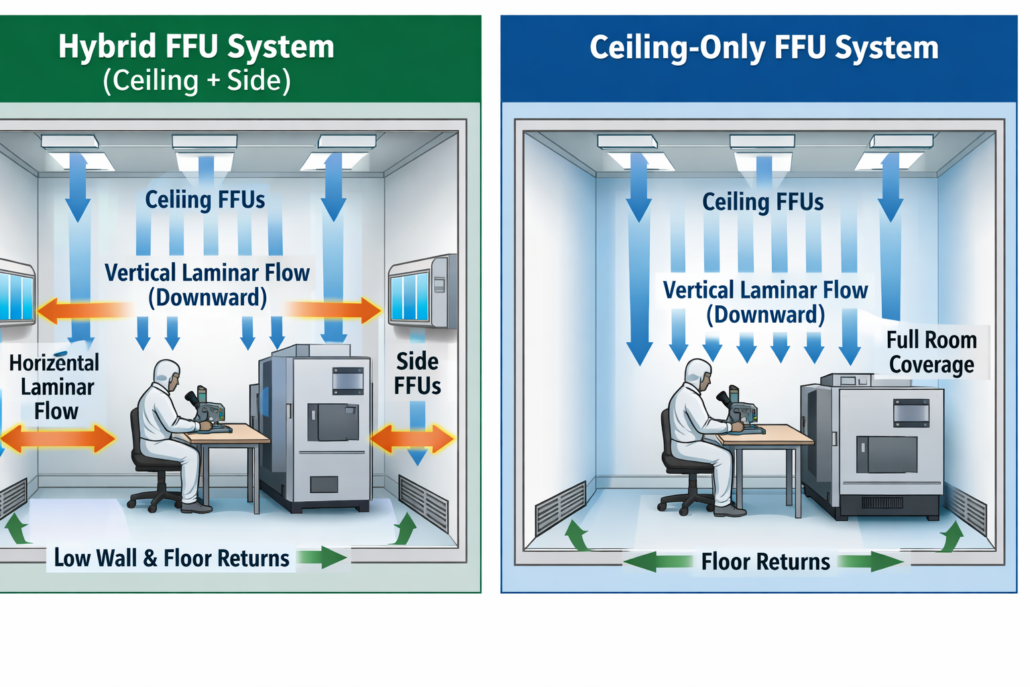
Unlike traditional FFUs that push filtered air downward, side-mounted FFUs:
-
Deliver horizontal or angled airflow
-
Are installed on walls, side plenums, equipment enclosures, or tool housings
-
Are often used when ceiling space is unavailable, restricted, or impractical

Side-mounted FFU VS ceiling FFU
2. Why End Users Choose Side-Mounted FFUs
From an end-user or contractor perspective, side-lifting FFUs are usually selected not because they are cheaper, but because ceiling FFUs cannot solve the problem.
Common reasons:
-
❌ No ceiling grid available
-
❌ Low ceiling height
-
❌ Ceiling already crowded with utilities
-
❌ Equipment needs localized clean air
-
❌ Retrofit projects where ceiling modification is too costly
Side FFUs give flexibility—especially in brownfield factories or equipment upgrades.
3. Where Side-Mounted FFUs Are Typically Installed
3.1 Cleanroom Walls
Used to:
-
Create horizontal laminar airflow
-
Support ISO Class 5–7 zones
-
Supplement ceiling FFUs
Typical industries:
-
Semiconductor
-
Optics
-
Precision assembly
-
Medical device manufacturing
3.2 Equipment Enclosures & Tool Interfaces
Very common in:
-
Lithography tools
-
Inspection stations
-
Laser processing equipment
-
Packaging machines
Here, the FFU:
-
Feeds clean air directly into the machine
-
Prevents particle ingress
-
Reduces reliance on whole-room classification
3.3 Retrofit Projects
From a contractor’s view, this is a huge advantage:
-
No ceiling demolition
-
Minimal downtime
-
Can be installed during production shutdown windows
4. How to Install a Side-Mounted FFU (Step-by-Step)
Below is a realistic installation approach, not just a theoretical one.
Step 1: Confirm Airflow Direction & Coverage
Before installation, determine:
-
Horizontal left → right or right → left airflow
-
Required air velocity (typically 0.3–0.45 m/s for laminar flow)
-
Coverage area downstream of the FFU
⚠️ Mistake to avoid:
Installing a side FFU without checking airflow interaction with exhaust or return paths.
Step 2: Prepare the Mounting Structure
Depending on location, you may need:
-
Wall cutout with reinforcement frame
-
Equipment panel opening
-
Support brackets or rails
Key contractor checks:
-
Structural load capacity
-
Vibration isolation
-
Sealing surfaces (flatness is critical)
Step 3: Install the FFU Housing
-
Insert or hang the FFU into the prepared opening
-
Secure using bolts or clamps (never rely on sealant alone)
-
Ensure filter face is perfectly aligned with airflow direction
Best practice:
-
Use neoprene or silicone gaskets to prevent air leakage
-
Avoid metal-to-metal contact where vibration could transfer
Step 4: Electrical Connection
Typical requirements:
-
110V / 220V / 380V depending on model
-
Speed controller or EC driver wiring
-
Optional BMS or PLC integration
Contractor tip:
-
Label every FFU circuit clearly—future maintenance depends on it
Step 5: Seal & Leak Test
Critical step often skipped:
-
Seal all perimeter gaps
-
Perform smoke test or PAO test
-
Check for bypass leakage around the filter frame
Step 6: Airflow Balancing & Commissioning
-
Measure airflow velocity
-
Adjust fan speed
-
Confirm uniformity across the clean zone
This step determines whether your cleanroom actually meets ISO requirements.
5. Maintenance Considerations (End-User View)
Side-mounted FFUs are generally:
-
Easier to access
-
Easier to replace filters
-
Less disruptive to operations
However:
-
Filters may load faster if close to process sources
-
Pre-filters are strongly recommended
6. Side-Mounted FFU vs Ceiling-Mounted FFU: Key Differences
| Aspect | Side-Mounted FFU | Ceiling-Mounted FFU |
|---|---|---|
| Airflow Direction | Horizontal / angled | Vertical downward |
| Installation Location | Wall, equipment, enclosure | Ceiling grid |
| Ceiling Dependency | ❌ Not required | ✅ Required |
| Retrofit Friendly | ⭐⭐⭐⭐ | ⭐⭐ |
| Laminar Flow Type | Horizontal laminar | Vertical laminar |
| Cleanroom Coverage | Localized / zoned | Whole room |
| Maintenance Access | Easy (side access) | Often above ceiling |
7. When You Should NOT Use a Side-Mounted FFU
From experience, avoid side FFUs if:
-
You need full-room ISO Class 3–4
-
Vertical unidirectional flow is mandatory
-
Ceiling height and grid are already available
In those cases, ceiling-mounted FFUs are still the gold standard.
8. Final Contractor & End-User Takeaway
Side-lifting FFUs are not replacements for ceiling FFUs—they are problem solvers.
They shine when:
-
Space is limited
-
Equipment needs localized protection
-
Retrofit speed matters
-
Flexibility outweighs uniform room coverage
Installed correctly, they:
-
Reduce project cost
-
Shorten installation time
-
Improve process cleanliness exactly where it’s needed