

Clean Booths vs. Traditional Cleanrooms (Cost, Timeline & ROI Comparison)
When your process demands contamination control, one key question determines your investment strategy:
👉 Should you build a traditional cleanroom—or deploy a modular clean booth?
Both solutions achieve controlled environments, but they differ dramatically in cost, installation speed, flexibility, and long-term ROI.
This guide breaks down everything you need to make the right decision—whether you’re an engineer specifying requirements or a facility manager optimizing budget and scalability.
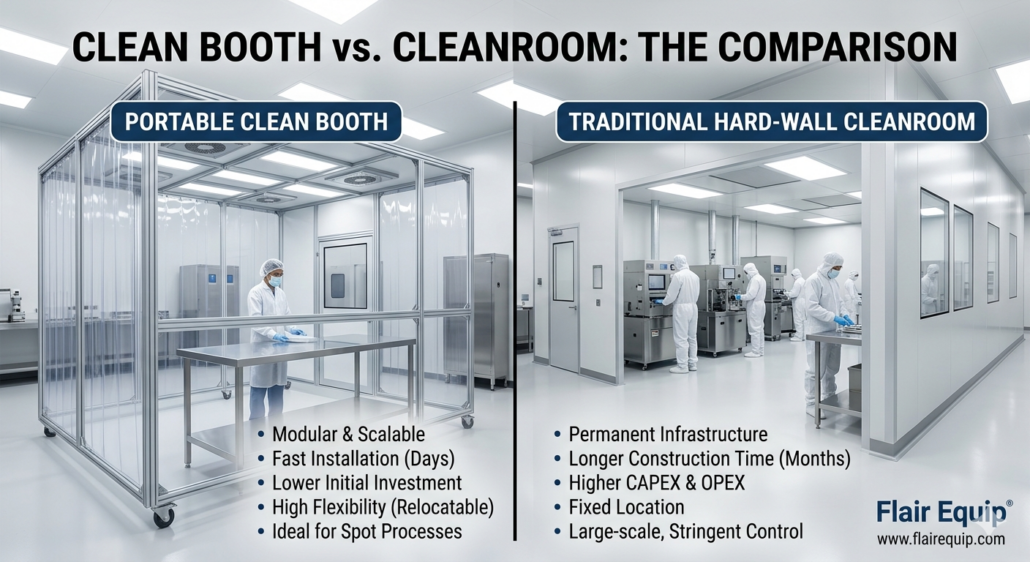
1. Definition Comparison
What is a Traditional Cleanroom?
A traditional cleanroom is a permanent, facility-integrated controlled environment. It is designed for high-scale, long-term operations requiring stringent environmental control.
Key Characteristics:
-
Hard-wall construction
-
Centralized HVAC system
-
Ducted airflow and pressure control
-
Advanced temperature & humidity regulation
-
Multi-room zoning (gowning, airlocks, etc.)
What is a Modular Clean Booth (Local zone)?
A clean booth is a modular, self-contained clean zone designed to isolate critical processes.It provides a “clean zone” within an existing larger facility without the need for structural renovation. Unlike traditional setups, it utilizes localized, ceiling-mounted Fan Filter Units (FFUs) to generate laminar flow.
Key Characteristics:
-
Aluminum or stainless steel frame
-
PVC curtains or acrylic panels
-
Integrated Fan Filter Units (FFUs)
-
Plug-and-play installation
2. Definitive Side-by-Side Feature Comparison Table
This table summarizes the core differences between the two systems across crucial operational metrics.
| Decision Matrix Feature | Modular Clean Booth (Portable) | Traditional Cleanroom (Stick-Built) | Winner for |
| Initial Cost (CAPEX) | Low – Moderate (Cost only the needed zone) | High – Very High (Engineering, Heavy Build) | Budget & ROI |
| Installation Timeline | Days to Weeks | Months | Speed-to-Market |
| Facility Disruption | Minimal (Prefab, Quick Assembly) | High (Construction Dust, Specialized Trades) | Operational Uptime |
| Flexibility (Future-Proofing) | High (Casters, Scalable, Movable) | Low (Fixed Walls, Hard Ducts) | Scaling Business |
| Maintenance & OPEX | Simple (FFU based, Localized) | Complex (Facility-wide HVAC, High Energy) | Long-Term Savings |
| Energy Consumption | Lower (Cleans less air volume) | Higher (Centralized Air Handling) | Sustainability & OPEX |
| Leased Facility Suitability | Ideal (Movable Asset, No Permits) | Not Recommended (Tenant Improvements) | Lease Tenants |
| ISO Classification Range | ISO Class 8 down to ISO Class 4 | ISO Class 8 down to ISO Class 1 | Application Needs |
3.Cost Comparison: CAPEX & OPEX Breakdown
💰 Traditional Cleanroom
-
High construction costs
-
Engineering + permits required
-
Expensive HVAC integration
-
Higher long-term energy consumption
💡 Clean Booth
-
Minimal facility modification
-
Lower upfront investment
-
Reduced airflow volume = lower energy cost
-
Faster ROI
👉 Key Insight:
A clean booth can reduce total cost of ownership by 30–70% depending on application.
you can check more details :https://www.technicalairproducts.com/2022/05/15/cleanroom-walls/
Traditional Cleanroom TCO
Traditional cleanrooms carry high “hidden costs.” Beyond the engineering and materials, you are investing in:
-
Civil Engineering & Building Permits: These require significant upfront capital and time.
-
Infrastructure Taxes: A traditional build can increase your facility’s property tax liability.
-
Energy Inefficiency: Centralized HVAC systems often run at lower efficiencies than localized FFUs, leading to high long-term energy costs.
-
Future Costs: Modifying a permanent build requires costly and disruptive demolition.
Clean Booth ROI
The clean booth ROI is dramatically higher because it minimizes both upfront investment and operational expenses:
-
Lower Initial CAPEX: You only pay to clean the air where the critical process takes place.
-
Modular Cleanroom Benefits: Your clean booth is a depreciable movable asset, not a tenant improvement, offering tax advantages.
-
Cleanroom Energy Cost Savings: A clean booth consumes significantly less energy than a full traditional facility. Localized FFUs can be throttled down or turned off when the zone is not in use, offering direct cleanroom energy cost savings.
4. Operational Comparison: Timeline and Flexibility
Installation Time
| Stage | Clean Booth | Traditional Cleanroom |
|---|---|---|
| Design | 1–3 days | 4–8 weeks |
| Fabrication | 3–10 days | 2–4 months |
| Installation | 1–3 days | 2–6 months |
Future-Proofing and Scalability
Your business needs will change. Your clean area should too.
-
A traditional cleanroom is static. If you need to move a production line or increase the clean area, you face significant facility disruption.
-
A modular clean booth offers unmatched flexibility. Mounted on heavy-duty casters or bolt-together frames, they can be relocated within the facility, disassembled for storage, or expanded seamlessly.
5.Maintenance & Compliance
Clean Booth:
-
FFU filter replacement
-
Simple cleaning protocols
-
Faster validation (IQ/OQ)
Traditional Cleanroom:
-
HVAC maintenance
-
Air balancing & duct cleaning
-
Complex validation procedures
👉 Result:
Clean booths significantly reduce maintenance time and compliance overhead.
6.ISO Classification Explained
Both systems can meet ISO standards:
-
Clean Booth: ISO 8 to ISO 5
-
Traditional Cleanroom: ISO 9 to ISO 1
👉 Important Insight:
Most industrial applications only require ISO 7–8, making clean booths more than suffici
7. Best Use Cases by Industry
A standard comparison focuses on generalities; we focus on strategic applications.
| Feature / Industry | Best Use Case: Modular Clean Booth | Best Use Case: Traditional Cleanroom |
| Electronics & Semiconductor | Specific CNC isolation, wafer inspection stations | Main assembly lines, extensive photoresist rooms |
| Pharmaceutical & Biotech | Product packaging, small-batch R&D labs, sterile filling spot isolation | High-volume production, multi-zone aseptic suites (Class 100/A) |
| Medical Device | Device assembly spot isolation, component packaging | High-volume aseptic sterilization, primary manufacturing |
| Laboratories & Research | Specific instrument isolation, short-term research projects, microscope protection | Large-scale long-term research facilities |
7. Strategic Solutions for Facility Managers and Contractors
At Flair Equip, we don’t just supply equipment; we solve contamination and budget challenges. We bridge the gap between temporary fixes and static infrastructure.(By Industry)
Choose a Clean Booth If You:
✔ Need localized contamination control
✔ Want fast deployment
✔ Operate in a leased facility
✔ Require flexibility for changing layouts
Choose a Traditional Cleanroom If You:
✔ Require multi-zone environments
✔ Handle hazardous materials
✔ Need ultra-precise climate control
✔ Operate in highly regulated industries
-
Agility: We help you maximize facility flexibility. If your production needs change, your clean environment can too.
FAQ: Clean Booth vs. Cleanroom (Featured Snippet Targeting)
This section targets common voice searches and featured snippet opportunities.
Can a modular clean booth achieve the same cleanliness as a traditional cleanroom?
Yes, for most applications. A modular clean booth can easily achieve ISO Class 5 (Class 100), Class 6 (Class 1000), or Class 7 (Class 10,000) classifications using high-efficiency FFUs, comparable to traditional builds. Traditional cleanrooms are typically required for ISO Class 1 to 3.
What are the main benefits of a portable cleanroom?
The primary benefits of a portable cleanroom (modular clean booth) include: significantly lower initial cost (CAPEX), fast installation (days vs. months), minimal facility disruption, extreme flexibility for relocation or expansion, and lower energy consumption.
Which system is better for a leased facility?
A modular clean booth is significantly better for leased facilities. It is a movable asset (not a permanent tenant improvement) and can be easily disassembled and relocated to a new facility if your lease changes, protecting your investment.
Does a clean booth require specialized HVAC?
Generally, no. A clean booth utilizes self-contained Fan Filter Units (FFUs) mounted in the ceiling to provide high-quality laminar flow, often eliminating the need for complex, facility-wide HVAC system modifications.
Is a clean booth GMP compliant?
Yes—when properly designed and validated, clean booths can meet GMP requirements.
Can clean booths be expanded later?
Yes—modular systems are designed for scalability and reconfiguration.
Are clean booths energy efficient?
Yes—because they control a smaller air volume, energy consumption is significantly lower.